
Published Articles
How Cottonwood Filter Screens Increase Operational Efficiency on Condenser Coil Systems
To the casual observer, Cottonwood Filter Screens look like a common mesh screen that simply stops airborne debris at it’s point of entry into mechanical systems – This is the “intuitive aspect” of the product however, the benefits of their construction and use go well beyond keeping debris out of condenser coils. What isn’t as intuitive is how they contribute to increasing cooling efficiency, driving down energy cost and simplifying the maintenance process. Click Here for the full story.

Process Chiller Efficiency & Operating Cost Are Only As Good As The Coils Are Clean!
Rising energy costs combined with the basic need to optimize cooling and operational efficiency are key forces driving the changes we see in today’s process chiller designs. More and more companies are moving to both “green” preventative maintenance practices and energy efficient equipment that provide greater heat rejection capability at lower operating costs. Click Here for the full story.
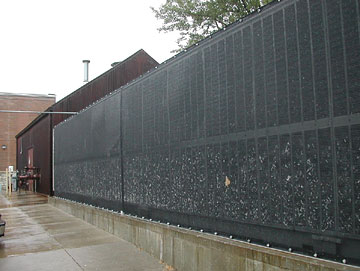
Cottonwood Air Intake Filter Screens Changing the Dynamics of Chiller and Cooling Tower Maintenance
When you think of chiller and cooling tower maintenance the first thought is usually about how much of a hassle it is to perform this important but unpleasant task; power washers, cleaning solvents hoses, buckets and other cleaning accessories need to be assembled and moved from unit to unit, up and down off of rooftops, behind buildings and other out of the way locations; chillers and cooling towers need to be opened, housings need to be removed and internal components power washed (all the while getting the debris from the cleaning process all over you) then the equipment needs to be reassembled before moving to the next one – WOW, what a hassle! Click Here for the full story.

Air Intake Filters Protecting Chiller Coils from Cottonwood Seed
Air Intake Filtration Technology Supports EPA’s Indoor Air Quality Tools for Schools Program
 Good indoor air quality is a critical element that contributes to a favorable learning atmosphere and helps ensure that all students and staff are working in a healthy environment. With continuing escalation in fuel and energy costs, school systems recognize the importance of optimizing the insulation of school buildings and sealing the building to prevent loss of heating and cooling. When buildings have been effectively sealed, the heating and ventilation system is a key element in regulating a safe internal environment. Click Here for the full story.
School District Chiller & Condensing Coil Maintenance Balancing Deferred Maintenance Risks With Maintenance and Budgetary Decisions
As most school district directors and maintenance engineers know, proper maintenance on chiller and condensing units is critical to efficient, trouble free operation. However when you combine the fact that most chillers and condensing units are situated in low traffic locations and out of sight (i.e., behind buildings, hidden behind walls, on rooftops, etc.,) with the fact that the coil cleaning portion of the maintenance process is an unpleasant and time consuming task, chiller and condensing unit maintenance isn’t one of those jobs that most maintenance engineers look forward to. In situations where the maintenance department is busy or understaffed, coil cleaning is likely to be deferred beyond the time when maintenance is actually required by the equipment. Click Here for the full story.
Healthcare Facility Chiller & Condensing Coil Maintenance Balancing Deferred Maintenance Risks With Maintenance and Budgetary Decisions
As most healthcare facilities and maintenance engineers know, proper maintenance on chiller and condensing units is critical to efficient, trouble free operation. However when you combine the fact that most chillers and condensing units are situated in low traffic locations and out of sight (i.e., behind buildings, hidden behind walls, on rooftops, etc.,) with the fact that the coil cleaning portion of the maintenance process is an unpleasant and time consuming task, chiller and condensing unit maintenance isn’t one of those jobs that most maintenance engineers look forward to. In situations where the maintenance department is busy or understaffed, coil cleaning is likely to be deferred beyond the time when maintenance is actually required by the equipment. Click Here for the full story.
Process Chillers & Condensing Coil Maintenance Balancing Deferred Maintenance Risks With Maintenance and Budgetary Decisions
As most facilities and maintenance engineers know, proper maintenance on chiller and condensing units is critical to efficient, trouble free operation. However when you combine the fact that most chillers and condensing units are situated in low traffic locations and out of sight (i.e., behind buildings, hidden behind walls, on rooftops, etc.,) with the fact that the coil cleaning portion of the maintenance process is an unpleasant and time consuming task, chiller and condensing unit maintenance isn’t one of those jobs that most maintenance engineers look forward to. In situations where the maintenance department is busy or understaffed, coil cleaning is likely to be deferred beyond the time when maintenance is actually required by the equipment. Click Here for the full story.
The Disastrous Effects of Deferring Maintenance
When we attempt to force maintenance spending into specific lumps of time that do not meet the needs of our machines, we create the need to defer maintenance. Maintenance budgets fail because final budgeting authorities do not understand the disastrous consequences of deferring maintenance. Click Here for the full story.
Periodic Cicadas Will Emerge In 16 States In 2004 They Can Overwhelm Your Cooling Towers, Evaporative Condensers and Air Handling Units If You’re Not Prepared!
 Did you ever wonder what insects make that very loud buzzing sound in trees during the daytime in summer? Well, it’s a widely heard but rarely seen kind of insect called a cicada. The ones you hear every summer are non-periodical, some of them appearing as adults every year despite requiring several years to develop to adulthood; but the ones appearing as adults in the next few years that can overwhelm your cooling towers, evaporative condensers and air handling units emerge as adults in 17 year intervals in large and generally non-overlapping geographic regions of the northeastern United States. Because of this separation in time and place, these species are called periodical cicadas, and their various widespread populations are called broods. A total of a dozen such broods are recognized. The single largest 17-year brood, known as “Brood X” [ten] is expected to appear in sixteen states in 2004, while another 17-year brood should appear in four states in 2007, and yet another in 12 states in 2008 (many the same as for Brood X). One can identify periodical cicadas by the combination of largely black bodies, reddish eyes, and reddish veins in their wings. If your company is in a region affected by Brood X this year, you need to begin planning how you will deal with the potential problem because it can have a devastating impact on your operation if you wait until it is too late. Click Here for the full story.
Cooling Tower Safety and Maintenance Aligning Debris Management and Water Treatment Procedures Is Key to Cooling Tower Safety and Efficiency
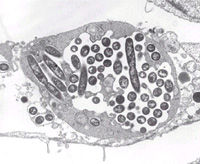
Legionella Bacteria multiplying inside of cultured human lung tissue. Photo Compliments of Centers for Disease Control
In 2001 a major worldwide auto manufacturer experienced a tragedy when four of its facilities maintenance employees became ill with pneumonia-like symptoms that ultimately claimed the lives of two. The cause – Legionnaires Disease caused by the Legionella bacteria found in one of the manufacturers process cooling towers. The company quickly moved to conduct a “cause analysis” by inspecting its cooling towers worldwide to identify how systems were being maintained and to determine best maintenance practices. This ultimately led to the establishment of a world class monitoring and maintenance procedure that ensures such a tragedy will never be repeated at the company. Click Here for the full article.
Keeping Cooling Towers and Heat Exchangers Clean is Key To A Healthy and Efficient Process Cooling System Filtration Systems Can Reduce Maintenance and Downtime.
To strike an interesting analogy, your cooling tower and heat exchanger is what the lungs and heart are to the human body; when either aren’t working properly, it effects other parts of the body and your health suffers. Similarly, when your cooling tower and heat exchanger isn’t clean, the heat exchange process doesn’t work efficiently and the health of your production and process cooling system suffers. Click Here for the full story.
Air Intake Filtration Prevents & Solves Air Intake Problems Improves Environmental Air Quality and Process Cooling Efficiency
Today more than ever before, mechanical, maintenance and process engineers are being challenged to provide effective solutions that help to optimize environmental air quality and process cooling efficiency, while reducing downtime and maintenance cost. Regardless of the technology used to process incoming fresh air, the challenge has always been keeping cooling towers and other HVAC systems clean because as fresh air is drawn from the outside into the system, it brings along with it a wide range of airborne debris that can impact air quality and clog the system, ultimately leading to downtime for cleaning and maintenance. Click Here for the full story.
Air Solution Company: Helping to Maintain Healthy Evaporative Cooling Systems Legionnaire’s Disease (Legionellosis) and Evaporative Cooling System Maintenance Recommendations
Because cooling towers, evaporative condensers and chillers are highly efficient at drawing large volumes of air to support the evaporative cooling process, airborne organic material is usually drawn into the water system and can contribute to microbial growth including legionella pneumophila. Click Here for the full story.
Air Solution Company – Case Study A Global Commitment to Going Green
With ten LEED certified facilities and millions of more square feet in the works, an extremely large and well-known global Internet company committed to running “Green” facilities was facing cooling and maintenance challenges at several of its data centers. In many regions across North America, airborne debris such as cottonwood seed, insects, leaves and more gets drawn into their cross-flow cooling towers resulting in fouling of the cooling tower Fill, Sump and strainers, thus reducing overall operational efficiency and increasing their maintenance and energy cost. “Our company is totally committed to a green building initiative across all areas of our company and we recognize that deployment of best practices relative to air movement and cooling of our data centers is central to increasing our operational efficiency and minimizing energy utilization – we therefore are committed to finding and deploying the best technologies to help meet our company goals” said Andy T., Facilities Engineering. Click Here for the full article.

Air Solution Company – Case Study Cottonwood Filter Screens Relieve Snow Build-up In Louvered Air Chamber
This approx. 65,737 square-foot bio-medical building at a major university houses bio-molecular research labs, instructional labs, classrooms, student project space, and faculty offices. This state of the art building is situated to create a connection between the main campus and the medical school and is designed for optimal building performance and energy savings. One of the facilities main air handling units had been experiencing on-going problems during the winter; snow would be drawn through the intake louver on one side of the building where it would accumulate on the MERV 8 pre-filters until the weight and moisture from the snow caused them to collapse; thus exposing the expensive MERV 15 bag filters which they relied upon to provide fine filtration to help in delivering optimal indoor air quality. Click Here for the full article.

Hospital Cooling Tower Case Study Airborne Debris Puts Baptist Hospital East Cooling Towers In Intensive Care!
Whether cooling towers are used for process or environmental cooling, proper tower maintenance is critical for ensuring optimal performance in meeting the cooling demands of the facility or operation. Airborne debris that gets drawn into cooling towers is the single biggest problem contributing to system fouling, reduced performance, downtime and maintenance cost. Click Here for the full story.
Success Story
Company: Major Automotive Manufacturing Facility – Detroit, MI.
Problem:
A major automotive assembly facility had faced significant downtime due to their robotic welding systems not holding tolerances and causing quality problems. After many days of the robotic manufacturer trying to solve the problem, one of the maintenance workers checked the heat exchanger and discovered that it was impacted with cottonwood seed, insects and other debris. Because the heat exchanger was so full of debris, it caused a reduction in the flow of the cooling water, causing the robotic welding equipment to run hot thus the cause of the problem. The source of the problem was the cooling tower that draws in massive amounts of air to support the evaporative cooling process. Because cooling towers operate as gigantic air scrubbers, airborne debris would get drawn into the cooling tower and build-up in the fill material and water basin and circulate through the heat exchanger where it would get lodged and clogged-up. When this would occur it would cause the manufacturer significant downtime and lost productivity as well as a significant reallocation of valuable maintenance resources to fix the problem. In short, hundreds of thousands of dollars in lost productivity and maintenance expense would be lost when this would occur.
Solution: Air Solution Company was called in by the chief engineer of the facility and was asked to conduct a cooling tower survey. During the survey, Air Solution Company recommended Air Intake Filters that would mount to the outside of the air intake opening on the cooling tower. It was explained that the filters were specifically designed to stop cottonwood, insects, leaves, paper, construction debris and other airborne matter that would get drawn into the system. Furthermore, Air Solution Company showed how the filters would significantly reduce their downtime and maintenance cost. After receiving the pricing proposal, the chief engineer decided to move ahead with Pulley Mount Air Intake Filters that included a galvanized storage container and a pulley hoisting mechanism that would allow them to simply raise and lower the filters as needed. Since their installation, they have not encountered any further problems – The Problem Was Solved! “Air intake filters have dramatically reduced the maintenance requirements for our cooling towers”, said the chief engineer. “Furthermore, the filters are very easy to clean – Now all we have to do is clean the filters with a broom or brush; we’ve put an end to having to shut down the tower to clean it – What a maintenance improvement this has been! Another benefit of using the air intake filters is that it has improved the effectiveness of our chemical treatment program because they remove the larger airborne debris that was the cause of our problem in the first place, allowing the chemical dosing to work on the smaller particulates; and because the filters remove organic debris that is a nutrient source for bacteria, it helps us to prevent proliferation of bacteria in the water, including Legionella. We recommend air intake filters to companies that have periodic or on-going problems with airborne solids getting into their cooling towers. They have truly benefited our operation at this facility. For us the cost of not having to shut down the welding line and reallocate our maintenance resources more than justifies the investment we made in the air intake filters – It was a sound purchase decision.”
Success Story
Air Intake Filtration Solves “Show Stopping” Cooling Tower Problems and Significantly Reduces Maintenance Cost
Whether your cooling towers are used for process cooling or environmental air, cooling tower performance is key to ensuring that the cooling demands of your operation are met. Airborne debris that gets drawn into cooling towers is the single biggest problem contributing to cooling tower downtime. No matter what the application is, proper maintenance is exceedingly important. When cooling towers are not properly maintained, they can bring production to a halt, reduce office productivity, increase maintenance cost and become a health hazard. Furthermore, when cooling towers don’t perform in process cooling applications, the cost of lost productivity can be staggering. The following case study demonstrates the kinds of problems that can occur with any cooling tower (process & environmental air applications) and how Air Intake Filtration can prevent and solve “show stopping problems.”
Case Study: Several modern medical buildings housing the corporate offices of Baptist Healthcare System as well as physicians offices and other health service facilities stand next to Baptist Hospital East (BHE), of Louisville, KY, the regions leading hospital for Oncology, Cardiology, Orthopedics and Neurosurgery.
The Problem: Over the past 16 years, managing the cooling of the buildings had been a challenge due to the maintenance requirements of two BAC (Baltimore Air Coil) cooling towers. Gilbert Fister, Properties Manager for BHE’s campus buildings, was faced with taking the towers out of operation for scheduled maintenance twice a year, plus, due to the high seasonal concentration of airborne contaminants that got drawn into the towers, they required unscheduled maintenance associated with system fouling and clogging. “In the spring and summer, Mayflies, pine needles and other matter would seriously clog our fill material and basin strainers and trigger a series of other operational problems,” said Fister. Although the BAC cooling towers are equipped with water filtration systems, they required weekly monitoring and cleaning and did little to protect debris from getting into the cooling water in the first place. Further, they did nothing to protect the fill material from getting clogged with the debris being drawn in, resulting in reduced thermal release efficiency as the cooling water passed through the fill material. Additionally, organic debris (insects, pine needles, cottonwood, leaves dirt and other airborne matter) would collect in the basin and decompose, resulting in sludge build-up that supported bacteria proliferation, plugged the basin strainers and reduced cooling efficiency when circulated through the chiller. On several occasions, debris got through the basin strainer, resulting in the solenoid blow-down valve getting stuck in the open position; this triggered automatic release of water treatment chemicals and prematurely drained the treatment chemical tank, requiring BHE to call for emergency refills. There were other times when the strainers got clogged and the blow-down valve stuck in the open position, resulting in the make-up water running until it caused the make-up water valve to shut-off – when this would happen, the system would neither blow-down nor release make-up water. On other occasions, the strainer wouldn’t be clogged but the passing debris would get stuck in the blow-down valve, keeping it in the open position and resulting in the loss of thousands of gallons of water and again emptying the chemical tank. During scheduled maintenance, the towers were routinely cleaned using a pressure washer and cleaning solvents – much of the work was focused on cleaning the fill material which had high concentrations of debris deposited on its surface. Over the course of a year, literally thousands of dollars were spent on just keeping the cooling towers operationally and ecologically sound. Gilbert was not satisfied with the situation and set out to improve the maintenance demands being placed on these important systems.
The Solution: While consulting with their maintenance contractor HMC Service Company of Louisville, KY, BHE realized that they needed a solution that would prevent debris from getting into the cooling towers in the first place rather than trying to manage the debris once it got drawn in. HMC suggested that they explore using Air Intake Filters that could be mounted to the air intake openings on the cooling towers. Gilbert researched this option and contacted Air Solution Company of Milford, Michigan – the leading producer of air intake filter systems. Unlike traditional air filters (commonly used in air handling unit filtration banks) air intake filter media is constructed of a UV & weather resistant, plastic coated polyester fiber material that resists mold and mildew, never needs changing and are easily cleaned using a brush, broom or shop vac. Since their installation in 1999, BHE has eliminated sludge build-up and has not experienced strainer or blow-down valve clogging. Furthermore, they have reduced their chemical consumption by over 100% and reduced their make-up water consumption by 35%. Because Air Intake Filters now keep debris out of the system, BHE hasn’t required unscheduled service due to system fouling – saving thousands of dollars in labor and service cost. In short, Gilbert “hit a home run” in reducing the maintenance and operational cost associated with their cooling towers. “Since the installation of the Air Intake Filters from Air Solution Company, we now only inspect our towers monthly and find little or no maintenance required versus our inspecting them weekly before the filters were installed and nearly every time finding a need for some maintenance work. Installing Air Intake Filters on our cooling towers has saved us countless dollars and has given me “peace of mind” knowing that we’re now optimizing our operational efficiency and protecting the core of our cooling towers.” Said Gilbert Fister.
Water Treatment and Mechanical Service Providers Perspective? Most companies and institutions that outsource their HVAC system services do so as a means of reducing their cost of operations while improving system efficiencies. This typically entails establishing annual service contracts with water treatment and mechanical contractors to ensure scheduled maintenance intervals. But to truly optimize the cost savings, the system itself must be efficiently equipped so that the savings realized through not maintaining an in-house HVAC service team isn’t lost to extraordinary and unscheduled service needs. In BHE’s case, their water treatment service provider contracted for annual service and chemical replenishment based upon normal maintenance and operation. But when chemical consumption dramatically increased because the blow-down valves would get stuck open, it was the chemical service provider that wound-up eating the added cost during the contract period. Hence, when the Air Intake Filters were installed, both BHE and their water treatment supplier were winners. According to Wayne Turchetta, Corporate VP, HMC Service Company, “BHE’s use of the Air Intake Filters have helped us to keep their cooling towers running optimally and has reduced our maintenance cycle time by nearly half. The advantage to the customer is that their towers are out of service for shorter periods of time during scheduled maintenance. Furthermore, it helps us free-up valuable service time, giving us greater flexibility to deploy our service team where they are needed most and to serve more customers per day. Because the Air Intake Filters do such a good job of helping keep BHE’s towers clean, they help us to optimize the profitability of our maintenance contract because we now only deploy resources at scheduled intervals and we have virtually eliminated unscheduled emergency maintenance at BHE. The end result of their using the Air Intake Filters is that both BHE and HMC have realized improved efficiency and cost savings”.
Benefits of Air Intake Filtration at BHE (recap):
- Stopped insects, pine needles, leaves, pollen, paper and other airborne debris from getting into cooling towers.
- Stopped clogging of fill material – enabling optimal thermal release.
- Helps prevent sludge build-up in basins.
- Stopped basin strainer clogging.
- Stopped malfunctioning of blow-down valve.
- Reduced consumption of water treatment chemicals by 100%.
- Reduced consumption of make-up water by 35%.
- Improved chiller efficiency.
- Eliminated unscheduled downtime and maintenance service calls due to clogging and fouling.
- Reduced maintenance cycle time by nearly 50%.
When it comes to maintaining cooling towers, it ultimately requires a team effort between the customer and the mechanical and water treatment service providers. Using Air Intake Filters in conjunction with a well managed water treatment program and scheduled maintenance program will ensure that cooling towers perform optimally, while helping avoid unscheduled emergency service. If you’re experiencing air intake problems with your cooling tower/s, air cooled chiller, air handling unit, condensers or intake louvers, Air Intake Filters may be just the answer you’re looking for.
Press Releases
Press Release (Detroit, Michigan), May 29, 2001
Air Solution Company Releases New Air Intake Filter System Helping To Prevent and Resolve Commercial and Industrial Air Intake Problems For use with Cooling Towers, Air Handling Units, Air Cooled Chillers and Air Intake Louvers.
Air Solution Company today announced that it had launched a new air intake filter specifically designed to pre-filter external air to remove airborne debris. Click Here for the full story.


